
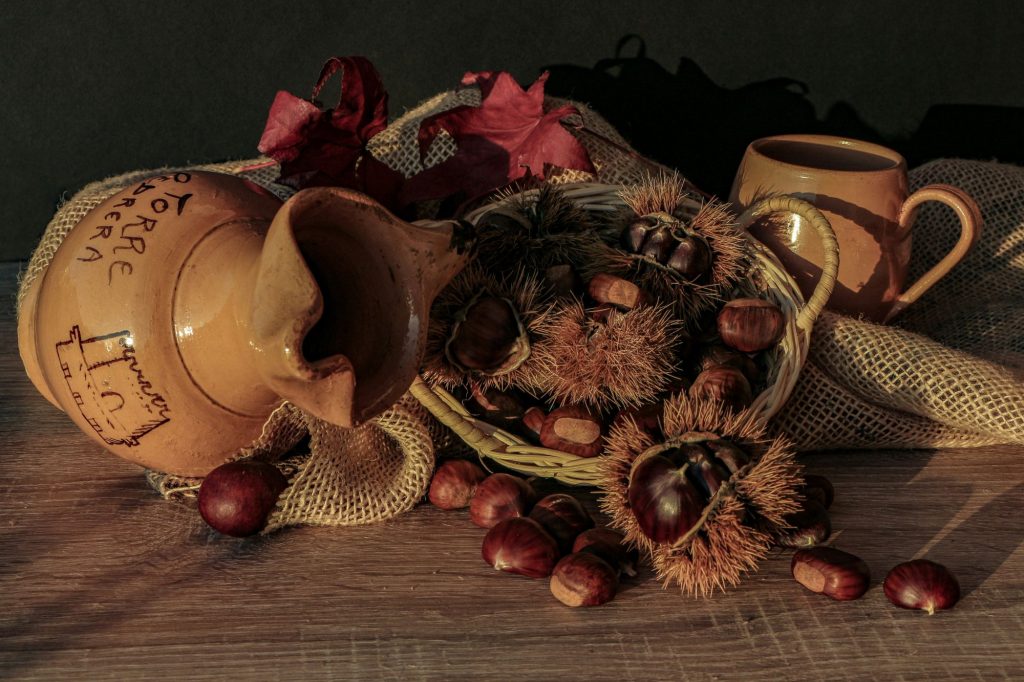
There is something rather special about November in Portugal. The days are getting shorter, the evenings are cooler, and the smell of roasting chestnuts begins to drift through the streets. Small street vendors appear with their charcoal braziers, paper cones filled with steaming chestnuts, and the unmistakable scent of autumn becomes part of everyday life.
It is a familiar scene across the country, and one that signals the arrival of São Martinho, celebrated every year on November 11th.
But behind the chestnuts, wine and autumn sunshine is a story that goes back more than 1,600 years.
The story of São Martinho
Martinho de Tours, known in English as Saint Martin of Tours, was born around 316 AD in the Roman province of Pannonia, in what is now Hungary. He followed a military career in the Roman army before converting to Christianity. Eventually, he became Bishop of Tours, in present-day France, and was remembered for his generosity and care for the poor.
His story is best known through a much-loved legend.
One cold and stormy day, Martin was travelling on horseback when he encountered a beggar sitting by the roadside, desperately trying to keep warm. Martin had little to offer, but he was wearing a large military cloak. Taking his sword, he cut the cloak in two and gave half to the man.
According to the legend, the weather suddenly changed. The dark clouds parted, the rain stopped and the sun appeared, bringing a spell of unexpected warmth.
That night, Martin is said to have dreamt of Jesus wearing the piece of cloak he had given to the beggar. The experience strengthened his Christian faith and became a lasting symbol of compassion and generosity.
This is the story behind one of Portugal’s most familiar expressions: Verão de São Martinho, or Saint Martin’s Summer.
What is Verão de São Martinho?
Around November 11th, Portugal sometimes experiences a welcome spell of warmer, sunnier weather, just when autumn begins to make itself felt. Temperatures can rise, the skies clear and people find themselves enjoying a few days that feel more like the end of summer than the approach of winter.
The Portuguese tradition attributes this change to Saint Martin and his act of kindness.
Of course, there is a meteorological explanation too. These warmer periods are associated with changes in atmospheric pressure and the arrival of stable weather conditions. They do not happen every year, but the legend has given this seasonal phenomenon a particularly charming place in Portuguese culture.
Magusto: A celebration of chestnuts, wine and togetherness
Ask a Portuguese person what São Martinho means to them and chances are the answer will involve chestnuts.
The traditional celebration is called Magusto, a gathering where family, friends and communities come together to roast chestnuts over an open fire. In villages and towns, bonfires bring people together, while in the cities, street vendors sell freshly roasted castanhas assadas, often served in paper cones.
The connection between chestnuts and São Martinho is closely tied to the agricultural calendar. November is chestnut season in Portugal, particularly in the northern and central regions, where chestnut trees have long been part of the rural landscape. The harvest provided an important food source, making chestnuts a natural part of seasonal celebrations.
Wine also has its place at the table. São Martinho traditionally marks the time to taste the new wine following the autumn harvest. Two drinks often associated with the celebrations are jeropiga, a sweet grape-based drink made by adding aguardente to grape must, and água-pé, a lighter traditional drink made using water added to grape pomace.
There is even a popular Portuguese saying that captures the spirit of the day:
“No dia de São Martinho, vai à adega e prova o vinho.” The english translation: On Saint Martin’s Day, visit the wine cellar and taste the wine.
It is a simple invitation to enjoy the fruits of the harvest and share them with others. It brings together religious history, an old European legend, the agricultural seasons and the pleasure of gathering around a table.
It is also a reminder of how deeply food and seasonal traditions are woven into everyday Portuguese life. Chestnuts are not simply something to eat when the weather turns cold, and wine is not just something poured into a glass. Both carry a connection to the land, the harvest and generations of shared customs.
So, if you happen to be in Portugal in November, look out for the chestnut sellers, follow the smell of the roasting fires and, if you have the opportunity, join a local Magusto.
You might even be lucky enough to experience a few days of Verão de São Martinho.
Discover the Schist Villages of Central Portugal
Chestnuts have long been part of rural life in Central Portugal. In the mountains, the Schist Villages preserve a connection to the land through their traditional architecture, local food and way of life.
Curious to discover them?
Explore our Schist Villages tour and experience another side of Portugal.
Traditional roasted chestnuts recipe
No São Martinho celebration would be complete without roasted chestnuts. Their warm, slightly sweet flavour and unmistakable aroma are part of autumn in Portugal. Traditionally cooked over an open fire, they can also be prepared easily at home using an oven.
Serves: 2 generous portions.
Ingredients:
500 g fresh chestnuts
Coarse sea salt
Boiling Water
Method:
- Preheat your oven to 200°C (180°C fan).
- Wash the chestnuts with water and dry them with a kitchen towel.
- Using a sharp knife, carefully cut a cross into the rounded side of each chestnut. This is important as it allows steam to escape during cooking and makes peeling easier.
- Place the chestnuts in a bowl and cover them with boiling water for 20 minutes, then drain.
- Spread the chestnuts on a baking tray, sprinkle generously with coarse sea salt and roast on the middle rack for 25–30 minutes, turning them once halfway through.
- They are ready when the shells have opened at the cuts and the flesh is tender.
- Allow them to cool slightly before peeling. Traditionally, they are enjoyed warm, straight from the fire, often accompanied by a glass of new wine.
A little Portuguese tip: Wrap the freshly roasted chestnuts in a clean kitchen towel for a few minutes before serving. This helps keep them warm and makes the shells easier to remove.
Bom apetite!